
After 24/7 Speed Cameras, Safety Projects, and over a Decade of Vision Zero, Historically Safe 2025 on New York City’s Streets Demonstrates the Need to Double Down on What Works
Traffic crashes killed 206 New Yorkers in 2025, tied for the safest year since 1910.
After major investments in safe streets infrastructure in the Bronx and Queens, fatalities plummeted, while safety gains plateaued in Manhattan, Brooklyn, and Staten Island.
Roads with stalled or watered-down safety projects remain dangerous.
Despite these safety gains, four New Yorkers on average were killed in a traffic crash every week in 2025.
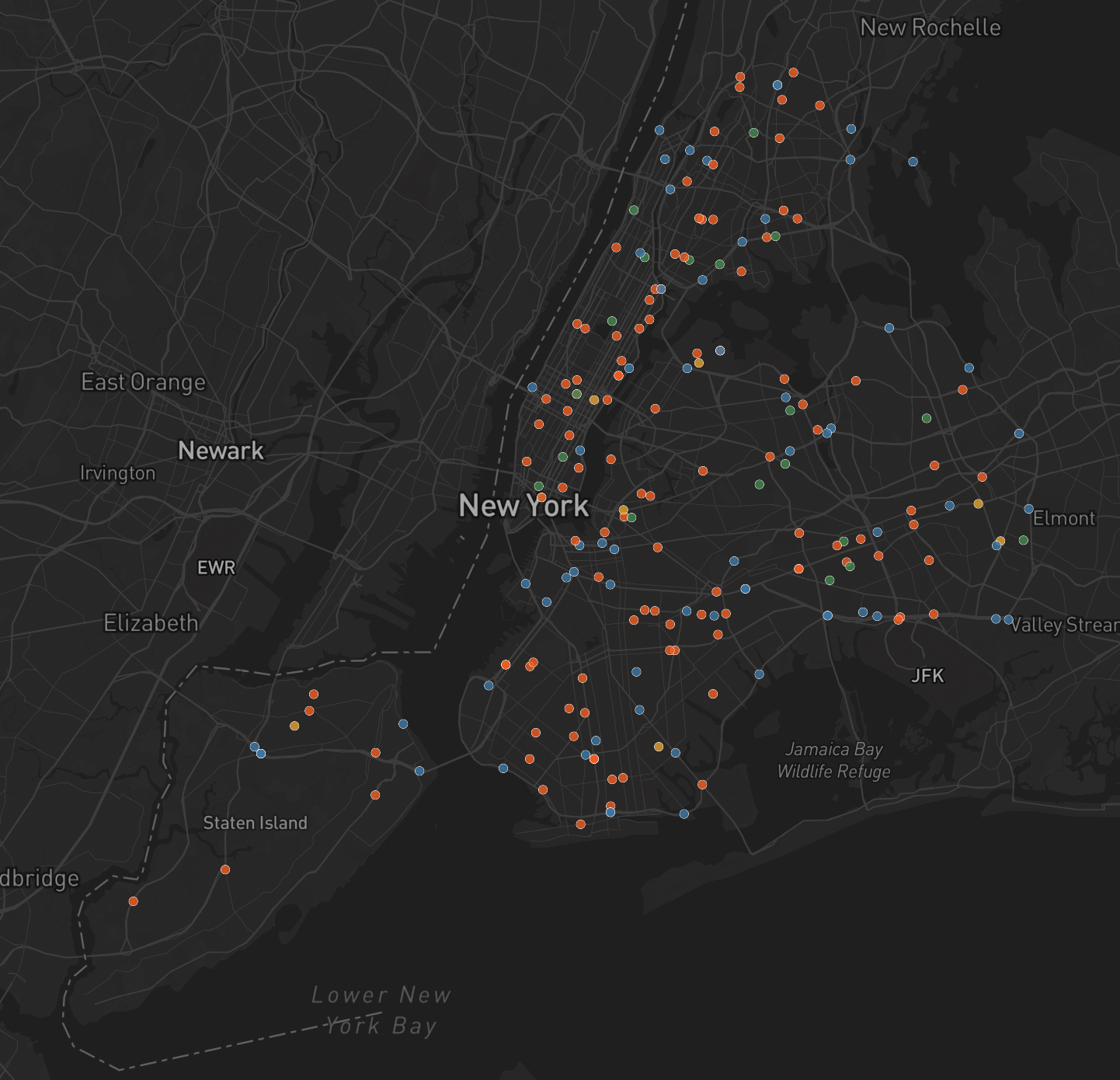
2025 fatalities. Source: Vision Zero Fatalities, Mapped
NEW YORK — In 2025, after the installation of 24/7 speed safety cameras, street redesigns, and over a decade committed to Vision Zero, traffic crashes killed 206 New Yorkers, making it tied for the safest year since 1910 and proving the need to recommit to Vision Zero, implement Sammy’s Law, finish stalled projects across the city, and finally stop super speeders, according to a new analysis from Transportation Alternatives and Families for Safe Streets.
“This research shows that New York City has made significant progress on making our streets safer, and that there is a huge opportunity to prevent life-altering injury and save lives,” said Ben Furnas, Executive Director of Transportation Alternatives. “The rollout of 20 mph speed limits and significant street safety redesigns were stalled under the previous administration, and they should move forward immediately. To reduce crashes, we also need universal daylighting so pedestrians and drivers can actually see each other at intersections, and we need to pass and implement the Stop Super Speeders program to slow down the most reckless drivers on our streets."
“Those of us who have lost loved ones in preventable crashes understand the stakes of inaction far too well,” said Families for Safe Streets Member Sarah Witt, whose brother Kevin Cruickshank was riding his bike when he was killed by a reckless driver on Canal Street last summer. “When street redesigns are stalled, New Yorkers get killed. My brother Kevin should still be with us today — we must act now before someone else’s loved one is killed in a preventable crash.”

Key takeaways from 2025:
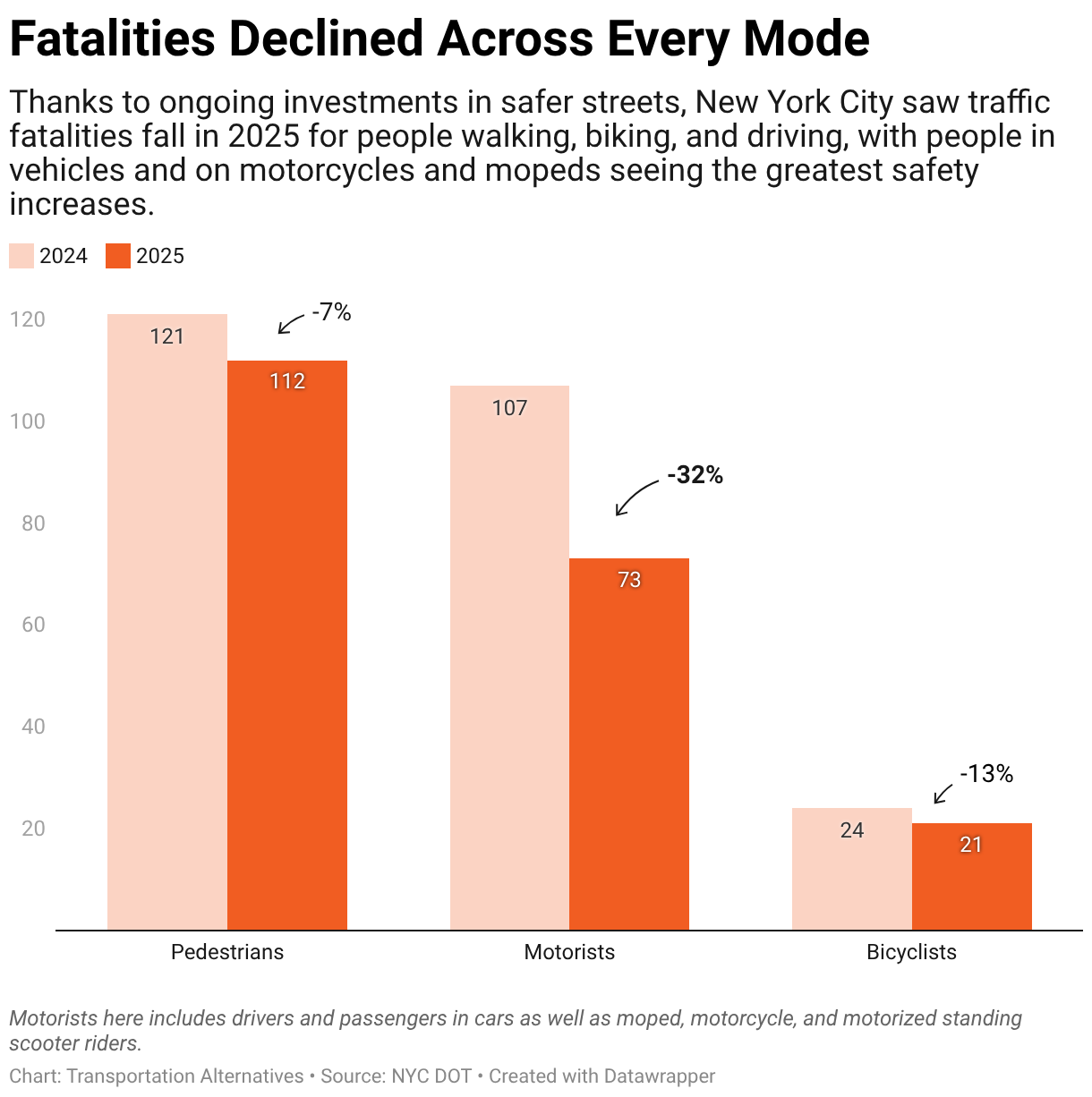
2025 is tied for the safest year since 1910. Traffic crashes killed 206 New Yorkers in 2025. With 18% fewer fatalities than 2024, this is the largest one-year drop in fatalities in more than 20 years. Every mode saw a drop in fatalities compared to the prior year.
Despite these safety gains, four New Yorkers on average were killed in a traffic crash every week in 2025. Traffic crashes killed 112 pedestrians, 73 motorists, and 21 people on bikes.
Streets are substantially safer in the Bronx and Queens. In the Bronx, fatalities were down by 38% from 2024 with 20 lives saved in 2025, and in Queens, fatalities were down by 22% with 16 lives saved. Fatalities fell less dramatically in Brooklyn and Manhattan, and rose slightly, by one, on Staten Island.

Shovel-ready projects abandoned by former mayor Eric Adams continue to put New Yorkers at risk. The prior administration watered down or put on ice multiple street redesign projects across the five boroughs. These streets remain dangerous because of that decision.
On Third Avenue in Sunset Park, 11 New Yorkers have been killed and seriously injured on the 2.4-mile stretch between 15th Street and 65th Street since the previous administration stalled its redesign in 2024. Despite longtime calls for a redesign and promised work in 2024, the street remains dangerous. A block over on Fourth Avenue, pedestrian injuries dropped by 29% after DOT installed a safety redesign.
On Fordham Road between 10th Avenue in Manhattan and White Plains Road in the Bronx, a busway and bus lane project was stalled by the Adams administration. Since the project was paused in September 2023, 35 New Yorkers have been killed and seriously injured along the road — and buses still crawl at under five mph.
Cyclist fatalities are falling. Traffic crashes killed 21 people on electric and traditional bikes in 2025, the same as the average of 21 during the Vision Zero era, three fewer than in 2024, and ten fewer than in 2023. Brooklyn in particular saw massive cyclist safety improvement, down from an average of eight fatalities to one. But cyclist fatalities in Queens more than doubled, from four to nine, and deaths also rose in Manhattan.
Motorist fatalities are falling. 73 motorists were killed in traffic crashes last year, 32% fewer than in 2024, saving 34 lives.
2025 was a substantially safer year for children. 2025 is tied for the fewest children killed in a single year during the Vision Zero era, with six lives lost compared to an average of 11. But the majority of children were killed in one borough: Brooklyn, including two eight-year-olds and one five-year-old, all of whom were killed while crossing the street.
89% of pedestrians killed in traffic crashes in 2025 were killed on streets eligible for Sammy’s Law. Sammy’s Law empowers New York City to lower speed limits on most streets from 25 mph to 20 mph, but the prior administration applied this power to a tiny percentage of eligible streets. In 2025, 82% of New Yorkers killed in traffic crashes were killed on streets eligible for Sammy’s Law speed limit reductions.

Here’s what our elected officials can do to address this crisis:
The Mamdani administration should recommit to Vision Zero. It’s time for City Hall to relaunch and recommit to the Vision Zero program with a focus on transforming streets for safety, elevating the role of traffic engineers, and expanding and improving automated enforcement. Re-launching Vision Zero means bringing more agencies into the Vision Zero Task Force; holding them accountable for reducing fatalities; publishing an annual update, with a look into all previous efforts and an emphasis on an all-of-government approach to street safety; and accelerating redesigns of the most dangerous corridors and intersections in every borough.
The Mamdani administration should move forward with all previously stalled projects. Across New York City, the Adams administration watered down or iced dozens of street safety projects, and these streets have continued to be dangerous. Last year, two men were hit and killed on Third Avenue, a stalled project in Sunset Park. Mayor Mamdani’s DOT has already committed to completing the safety project on McGuinness Boulevard in Greenpoint, and similar projects must be finished.
The Mamdani administration should implement Sammy’s Law. Sammy’s Law empowers New York City to lower the speed limit to 20 mph on the vast majority of roads in the five boroughs, but the Adams administration implemented the program on just 1.5% of eligible streets. Today, 96% of New York City streets are eligible but remain at 25 mph. The Mamdani administration must widely implement Sammy’s Law to save lives across the city.
Albany and New York City should work to Stop Super Speeders. The Stop Super Speeders bill would require mandatory intelligent speed assistance technology for repeated speeders to ensure they follow the speed limit. Repeat offenders are an overall small number of drivers that are disproportionately responsible for deaths and serious injuries on our streets. When ISA technology was implemented in the New York City fleet, hard brake events fell by 36% and vehicles followed the speed limit 99% of the time. This pilot program must be included in the final state budget and the mayor should work with the governor and legislature to get it done.
New York City should daylight every intersection. Repurposing the parking spots closest to an intersection to improve visibility — a practice known as daylighting — is proven to make intersections safer for people walking, biking, and driving. New York State bans parking within 20 feet of intersections — but New York City has overridden this law, allowing parking right up to the crosswalk. This exemption must be repealed, and daylighting must be implemented at every intersection in the five boroughs.
What elected officials are saying:
“Vision Zero is not a slogan—it is a promise. A promise that no one should lose their life simply trying to get home. The fact that 2025 was among the safest years in more than a century shows what is possible when we choose to invest in safer streets. Where bold action moved forward, lives were saved. Where safety projects stalled or were weakened, danger remained,” said State Senator Robert Jackson. “That is why I proudly stand with Transportation Alternatives and the families calling for action to stop super speeders. Preventing traffic violence is not about punishment—it is about responsibility, accountability, and the fundamental right of every New Yorker to walk, bike, and ride transit without fear. I will continue fighting for the policies and investments that turn Vision Zero from a goal into a lived reality.”
"This report is a glimmer of hope: after years of hard work, our streets are getting safer," said State Senator Andrew Gounardes. "I fought for speed cameras, Sammy's Law and street redesigns for a simple reason—they save lives. We've made real progress toward creating a transportation system that truly works for all New Yorkers, but we can't take our foot off the gas just yet. It's time to fast-track proven safety strategies and keep up this vital work until no New Yorker is killed on our streets."
"Creating infrastructure aimed at improving traffic safety is essential. The efficacy of these efforts is clear in the reduced number of traffic crashes in communities where safer street designs have been implemented. I am proud to cosponsor legislation that addresses super speeders and grateful to Transportation Alternatives for their leadership and advocacy on this important issue,” said State Senator Jose M. Serrano.
"Street safety should not depend on a ZIP code. Our communities in Queens have seen what’s possible when we invest in safer streets, while other neighborhoods are still waiting as projects stall and dangers persist. Every community deserves streets that protect families, workers, and children. Albany must act to stop super speeders and give New York City full authority under Sammy’s Law to save lives across all five boroughs,” said State Senator Jessica Ramos.
“Older New Yorkers should be able to cross the street, visit neighbors, and live independently without fearing traffic violence. While Vision Zero has saved lives, the data makes clear that progress is uneven and far too many seniors remain at risk—especially on corridors where safety projects have stalled. We must strengthen enforcement and pass Stop Super Speeders to hold the most dangerous drivers accountable and protect our most vulnerable road users,” said Assembly Member Rebecca Seawright, Chair of the Assembly Aging Committee.
“Every life lost on our streets is one too many. While it’s encouraging to see traffic fatalities decline where we’ve invested in proven safety infrastructure, the data is clear: when we stall or water down safety projects, people pay the price. Albany has a responsibility to act with urgency, including passing commonsense measures like Stop Super Speeders, so we can save lives and make our streets safe for everyone—drivers, pedestrians, cyclists, and families alike,” said Assemblymember Reverend Al Taylor.
"Vision Zero is about saving lives, and in 2025 we saw meaningful progress; especially here in the Bronx. Our borough saw traffic fatalities drop by 38 percent compared to 2024, saving 20 lives in just one year," said Assembly Member Jeffrey Dinowitz. "That’s an important reminder that when we focus on data-driven, proven safety measures, we can make real improvements for Bronx families and communities. There is still more work ahead, but these results show that street safety efforts are making a difference."
“2025’s record-low traffic fatalities should give New Yorkers a renewed sense of hope, but we must remember that this work isn’t finished,” said Brooklyn Borough President Antonio Reynoso. "If we want to continue saving lives, we have to plan for and invest in safer streets—that includes reviving stalled proposals such as the Sunset Park Street Safety Plan, recommitting to the Streets Plan, and delivering on universal daylighting.”
"Our success in reducing traffic fatalities proves one fact: safer streets save lives. Even as we acknowledge our progress, we must remember that every traffic death is preventable. We know where street safety is weakest, and we know what interventions will make streets safer. All we need is the will to put people first," said Majority Leader Shaun Abreu, Chair of the City Council’s Transportation Committee.
“Street safety for New Yorkers, whether they are walking, cycling, or driving a car, is a top priority for me in the City Council. Transportation Alternatives released a report that shows that when the City takes decisive action to make our streets safer, crashes, deaths, and fatalities go down. I’m proud to champion the next steps in street safety, such as universal daylighting and stricter speed limits,” said Council Member Shekar Krishnan, on the Transportation Committee.
"New York City's streets are the safest they've ever been, and while that's something to celebrate, we can't accept a status quo where more than 200 of our neighbors are still being killed in traffic each year. To save lives, we need universal daylighting and widespread implementation of Sammy's Law,” said Council Member Shahana Hanif, on the Transportation Committee.
"I represent Sunset Park, a neighborhood which has had to shoulder immense tragedy as a result of traffic deaths and street safety issues. Our community has advocated for an investment in ending this violence, and yet, multiple street safety projects have been stalled. I'm glad that Transportation Alternatives continues to report on every instance of traffic violence to shine a light on what policy limitations exist in our city. I hope in 2026, we can map out safer streets and protect our vulnerable neighbors," said Council Member Alexa Avilés.
Methodology:
Transportation Alternatives' total traffic fatality count for 2025 is 206, which has been confirmed by NYC DOT. Our count varies from DOT's January 2nd statement that there were 205 deaths because 1) a pedestrian who was hit on December 9th, 2025 was pronounced dead on January 5th, 2026; 2) DOT notified us of an e-bike rider who was also hit and killed in Queens in December, which was not previously included in their fatality list; and 3) a driver killed in Manhattan in October 2025 was determined to have crashed as a result of a medical incident, which is not considered a Vision Zero fatality and therefore removed.
We also report that 252 people were killed on New York City streets in 2024, which varies from NYC DOT's recent claim that there were 253 deaths in the year. This was also a change between DOT's January 2nd report and our publication, and has been confirmed by DOT.
We have combined some mode categories for simplicity, such as motorists (drivers, passengers, motorcycle riders, and legal moped riders) and other motorists (illegal moped riders, stand-up scooter riders, ATV and dirt bike riders, etc). Given the significant overlap in possible speeds, size, and acceleration, and common definitions, we felt it was clearer to regard them as one category. Cyclists are classified as people on both traditional bikes and e-bikes in all of TA’s Vision Zero reports.
###