
Research Reveals Bike Ridership for NYC Women Rises with Protected Bike Lane Access at a Much Higher Rate Than Men; Advocates Call for Connected Bike Network to Achieve Gender Parity
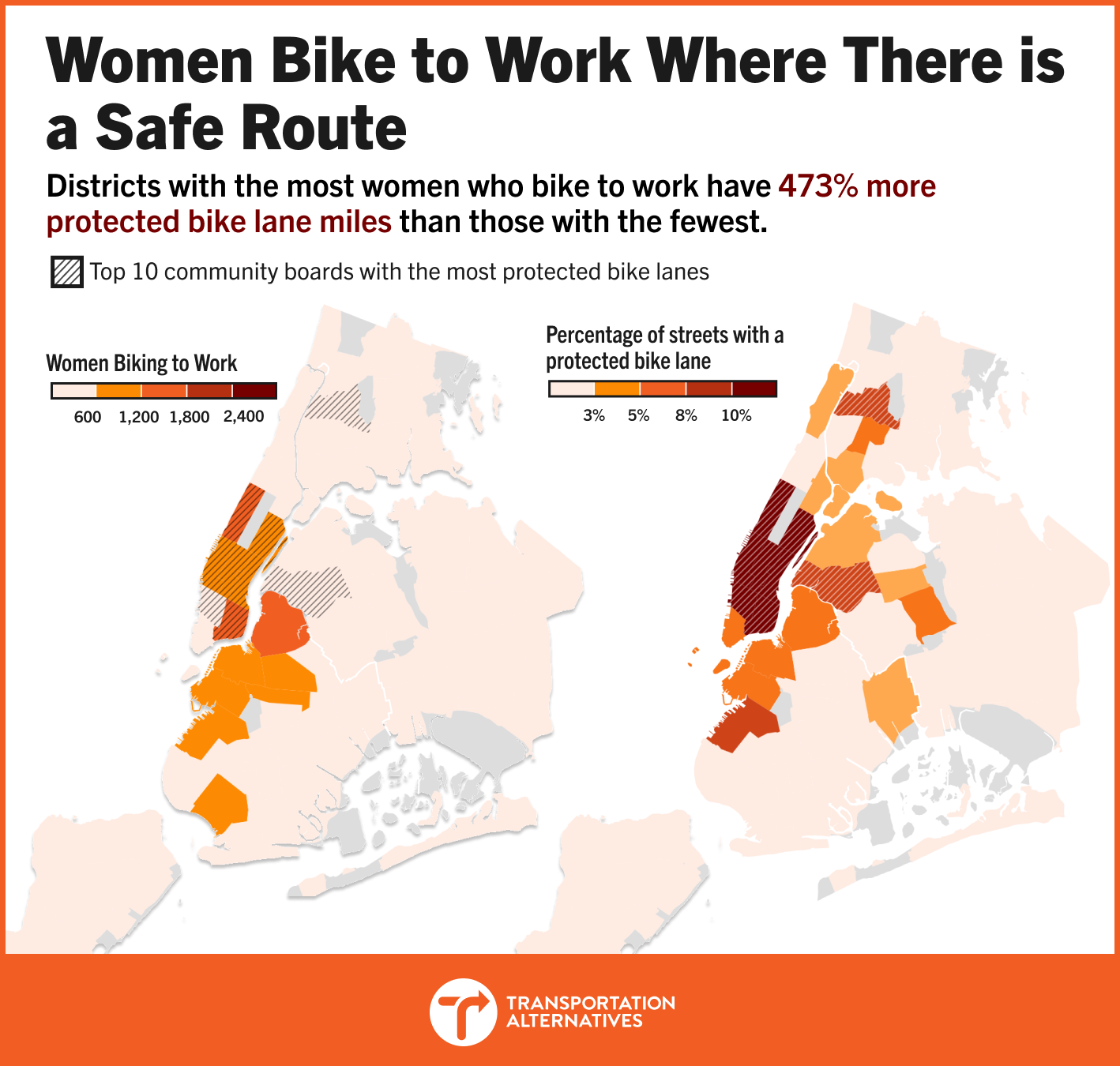
Districts with the most protected bike lane access have more than three times as many women who bike to work as those with the least protected bike lane access.
Districts with the most women who bike to work have nearly six times as much protected bike lane access as those with the fewest.
In the average community district, 2.6 times as many men as women bike to work.
NEW YORK — New research from Transportation Alternatives has revealed a significant “bike lane gender gap” in New York City, where women are substantially more impacted by incomplete or limited bicycle infrastructure than men.
While all New Yorkers are more likely to commute by bike when they live near a network of protected bike lanes, this is especially true for women. Women are significantly more likely to commute by bike when they live in a community district with more miles of protected bike lanes, and significantly less likely to do so when they live in a district with fewer. Men, who commute by bike at more than twice the rate as women, are impacted by the presence of a protected bike lane to a lesser degree than women.
Women and men move differently throughout the city: women are less likely to have access to a vehicle, more likely to trip-chain (i.e. combine commuting with other tasks or errands), and more likely to take trips unserved by current transportation options — the exact types of trips that are easier with a bicycle. However, because the current protected bike lane network touches only 3% of New York City streets and is riddled with gaps and dead ends, women often feel unsafe biking on unprotected streets, and men are 2.6 times more likely than women to bike to work. An incomplete bike network disproportionately limits women's mobility in New York City.
Biking is one of the most affordable and efficient ways to move around New York City — but if women are less likely to ride without access to protected bike lanes, then women and men do not have equal access to biking as a transportation choice. The bike lane gender gap operates as a transportation “pink tax”, requiring women to use more costly or less efficient forms of transportation.
“New York City is in an affordability crisis, and riding a bike can be one of the most affordable, efficient forms of transportation. But this road to affordability is not accessible to everyone. Women are uniquely stranded by our incomplete bike network,” said Elizabeth Adams, Deputy Executive Director for Public Affairs. “The bike lane gender gap is real and pervasive, with consequences that are physical, emotional, and economic. Every New Yorker should have safe access to a protected bike lane and have the choice to ride a bike. We get there by closing the gaps in our bike lane network.”
“The numbers are clear. When women have access to protected bike lanes locally, they take advantage of this uniquely convenient and affordable transportation option. When they don’t, they’re stuck,” said Research Manager Em Friedenberg, who led this analysis. “Women are more likely to combine commuting with errands and caretaking tasks, and this propensity for ‘trip-chaining’ is well-suited for the customizable nature of bicycling. When the protected bike lane network is incomplete, it is women’s mobility that suffers the most.”Transportation Alternatives calls on the Mamdani administration to expand and close the gaps in the bike lane network.
Key Findings
The top ten New York City community districts with the greatest percentage of streets with a protected bike lane have 226% more women who bike to work than the ten districts with the lowest percentage.
The top ten community districts with the most women who bike to work have 473% more streets with a protected bike lane than the ten with the fewest women who bike to work.
The top ten community districts with the most protected bike lane access have 94% more female residents who bike to work, but only 49% more male residents who bike to work, compared to the average district.
The ten community districts with the fewest female bike commuters are:
Staten Island Community District 2 (tied)
Staten Island Community District 3 (tied)
Queens Community District 11
Staten Island Community District 1
Queens Community District 10
Queens Community District 12
Bronx Community District 4
Bronx Community District 12
Bronx Community District 5
Brooklyn Community District 17
The 10 community districts with the most female bike commuters are:
Manhattan Community District 7
Manhattan Community District 3
Brooklyn Community District 1
Brooklyn Community District 3
Brooklyn Community District 8
Brooklyn Community District 2
Manhattan Community District 8
Brooklyn Community District 7
Manhattan Community Districts 5 and 6
These findings come in advance of this weekend’s 5th annual “Women’s Ride,” an annual ride for women and non-binary cyclists — this year’s edition is dedicated to caregivers. Women who are caregivers — especially teachers and nurses who commute at off-peak hours, as well as parents who need to trip-chain and transport small children — particularly benefit from access to protected bike lanes.
Methodology: This analysis relies on data from the 2024 American Community Survey 5-year estimates, and New York City Bike Routes from NYC DOT, accessed with spatialequity.nyc.
###