
What We’re Expecting From the Streets Plan Under Mamdani
“We’re bringing the Streets Master Plan back to life,” Mayor Mamdani announced on February 13. Flanked by DOT Commissioner Mike Flynn and MTA Chair Janno Leiber, the press conference — relaunching pedestrian, bike, and bus projects stalled by the Adams administration — was the highest level of interagency transportation coordination that New York City has seen in … well, about four years.
This was what the Streets Plan was meant to do — force mayors to coordinate city agencies to bring our streets in line with our ambitions, from air quality improvements to Vision Zero. Passed into law by the New York City Council in 2019, the Streets Plan set ambitious metrics for bike lane mileage, bus lane mileage, and, for a time, pedestrian plaza acreage, and thorough requirements to plan ahead, publicly, and report on progress.
Mayor Eric Adams governed like he had never heard of them. It appears that the Mamdani administration may be taking a different tack.
As mayor, Mamdani said he wanted to make New York City’s streets the envy of the world. His earlier announcement indicates that it may be more than just rhetoric. However, he has his work cut out for him.
On March 3, at a hearing on the Streets Plan before the New York City Council, DOT Commissioner Mike Flynn will testify as to what’s been done, what remains, and how he is planning to get it done. We have a few suggestions:
One, fully fund and staff the Department of Transportation. The resources and expertise to address existing shortfalls and move forward are ready and available.
Two, implement Sammy’s Law 20 mph zones in every New York City school zone. With hardened gateways and traffic calming within a ½ mile of every school, the City of New York can focus resources on the most needful locations while making wide tracts of the city safer.
Three, expedite the Streets Plan. To address the shortfalls of the Adams administration, encourage the Department of Transportation to expand its technical staff and equipment for concrete pouring and curb installation, permit the agency to move forward independently to harden and make permanent bike lanes and pedestrian space, and provide resources to expand municipal concrete and asphalt production. Allow the DOT to count the hardening of existing bike lanes and pedestrian space, with at-grade construction and concrete buildouts, toward Streets Plan mileage and square footage.
Four, reimplement and expand pedestrian plaza metrics. Unlike other metrics, the original annual requirements for pedestrian space in the Streets Plan ended in 2023. Space for people on foot should be a permanent, non-sunsetting feature of the Streets Plan. Commit to building a pedestrian plaza in every community board district without one in the next three years.
Five, catch up to the legal requirements of the Streets Plan. Mayor Adams’ complete disregard for the law set a dangerous precedent for disregarding the powers of the City Council, and leaves New Yorkers at risk. Set an expectation that the administration must correct the shortfalls of prior years and meet the numeric metrics required by law each year.
Six, set outcome targets. While the metrics set by the Streets Plan are essential to meet, the quality of those metrics -- as measured by their use -- is also important. Measure the effectiveness of the Streets Plan by setting goals for use, such as 1 million daily bike rides by 2030, citywide bus speeds increasing by 20%, a 10% reduction in transportation pollution, a 20% increase in plaza visitors, a 40% reduction in VMT, and 75% of trips shifted to sustainable modes by 2035.
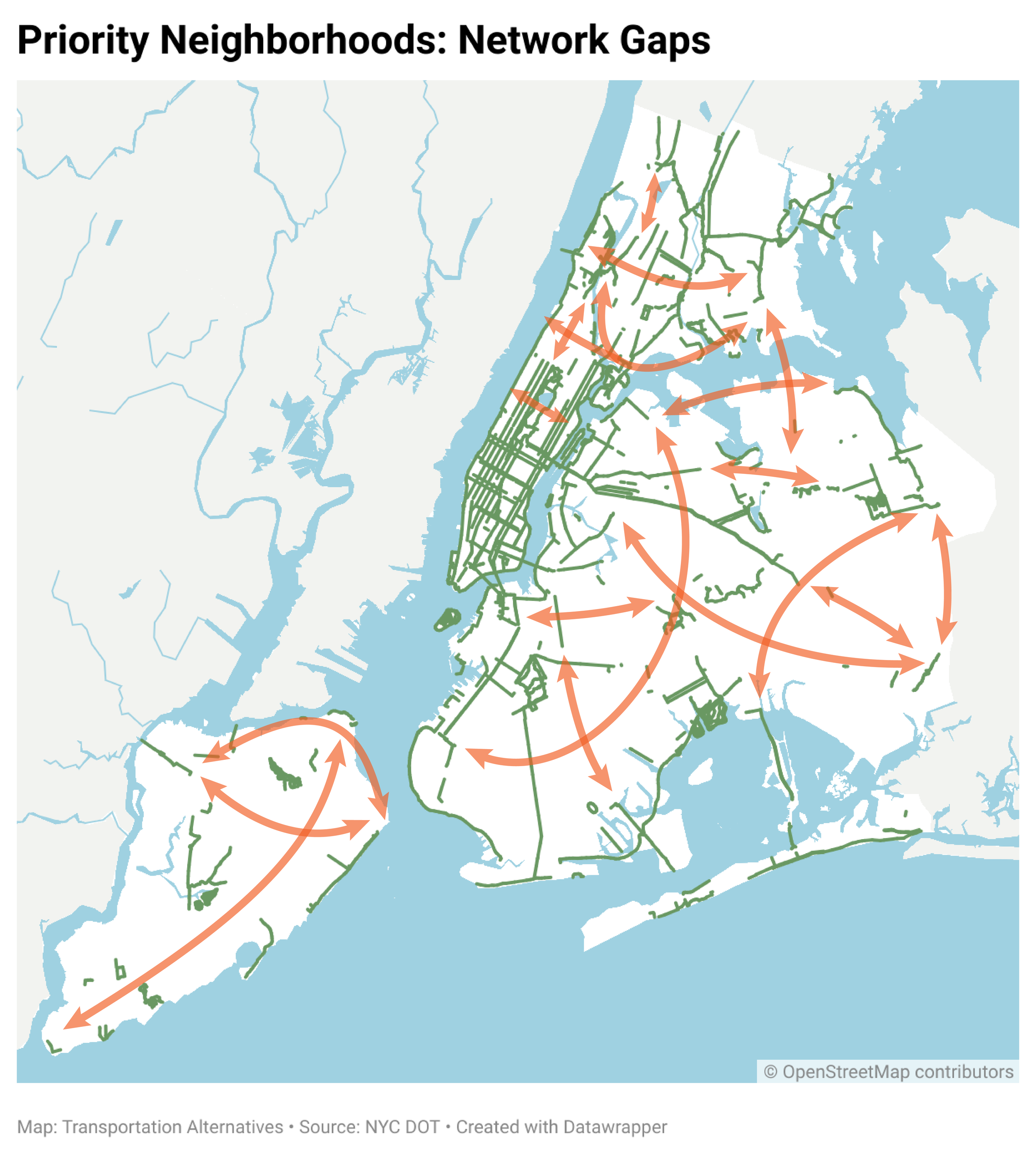
And last, dictate a focus on a connected network of protected bike lanes. No bike lane should ever end without connecting to another. The bike network is riddled with gaps and glaring omissions. As the DOT plans additions to the protected bike lane network, the focus should be on those disconnected destinations.

When the City Council passed the Streets Plan, it transformed New Yorkers’ understanding of the potential of streets and transportation — and set safety as an urgent, ambitious goal for City Hall. While mayoral administrations have too often failed to meet that urgency and ambition, the current administration and the next edition of the Streets Plan have the potential to match aspiration and action.